Why Freshers Get Rejected After Applying for 100+ Jobs: Freshers Not Shortlisted Reasons
For many fresh graduates in India, the job search journey starts with hope and quickly turns into frustration. After completing degrees, certifications, or even internships, freshers enthusiastically apply to dozens—sometimes hundreds—of job openings. Yet, weeks pass without a single interview call. This experience often leads to self-doubt, confusion, and the uncomfortable question: why freshers not shortlisted even after applying to 100+ jobs? This growing concern around freshers not shortlisted has become one of the biggest challenges in today’s competitive job market.
The reality is that rejection at this scale is rarely about intelligence or potential. It is the result of how modern hiring systems work, how companies filter applications, and how job platforms interpret candidate data—factors that silently decide why freshers not shortlisted in most cases. Hiring today is no longer driven purely by human judgment. Algorithms, automated screening tools, and skill-matching logic play a decisive role long before a recruiter ever sees a profile. Unfortunately, most freshers are unaware of this shift. They continue using outdated job-hunting methods in a system that has already evolved, which further explains why freshers not shortlisted repeatedly.
Understanding the real reasons behind repeated rejection is the first step toward changing outcomes. This blog explores those reasons deeply, without oversimplification, so freshers can clearly understand why freshers not shortlisted, where things break down, and how the hiring ecosystem actually evaluates them.
The Reality of Fresher Job Rejections in India
India produces millions of graduates every year, creating one of the most competitive entry-level job markets in the world. While opportunities do exist, the supply of candidates far exceeds the number of fresher-friendly roles. Companies receive thousands of applications for a single opening, especially in roles related to IT, marketing, HR, operations, and customer support. In such an environment, rejection becomes the default outcome for most applicants—not because they are unqualified, but because filtering has to be ruthless.
What freshers often fail to realize is that most rejections happen silently. There is no rejection email, no feedback, and no explanation. The application simply disappears into the system. This happens because recruiters rely heavily on automated tools to reduce manual effort. These systems are designed to eliminate profiles quickly based on predefined rules. If a profile does not meet those rules, it never reaches the shortlisting stage. This is one of the biggest hidden reasons why freshers do not get shortlisted despite applying consistently.
Another harsh reality is that entry-level hiring in India has shifted from potential-based evaluation to relevance-based filtering. Recruiters are no longer asking, “Can this candidate learn?” Instead, they are asking, “Is this candidate job-ready right now?” This subtle shift disadvantages freshers who rely only on academic qualifications. Degrees alone no longer communicate readiness. Employers want signals that indicate practical skills, adaptability, and immediate contribution. When these signals are missing or unclear, applications are filtered out automatically.
Why Resumes Fail to Represent Real Skills
The traditional resume was never designed for today’s hiring environment, which is one of the key reasons freshers not shortlisted even after applying for multiple roles. It was created for a time when recruiters manually read each application. Today, resumes are first read by machines, not humans. Unfortunately, most freshers still write resumes as static documents that list education, projects, and certifications without context. These resumes fail to communicate actual capability, and as a result, they fail in automated screening systems, leading to freshers not shortlisted despite having relevant skills.
Resumes also struggle to capture learning agility and problem-solving ability. These traits matter deeply in fresher hiring, but they are hard to express in bullet points. As a result, resumes become lists of facts rather than narratives of capability, which again explains why freshers not shortlisted during the initial screening stages. Some modern platforms attempt to solve this gap by focusing on skill signals rather than document-based screening. Skill-first ecosystems like Remark reflect this shift by prioritizing what candidates can do over how well they format a resume.
The Hidden Role of Automated Screening and ATS
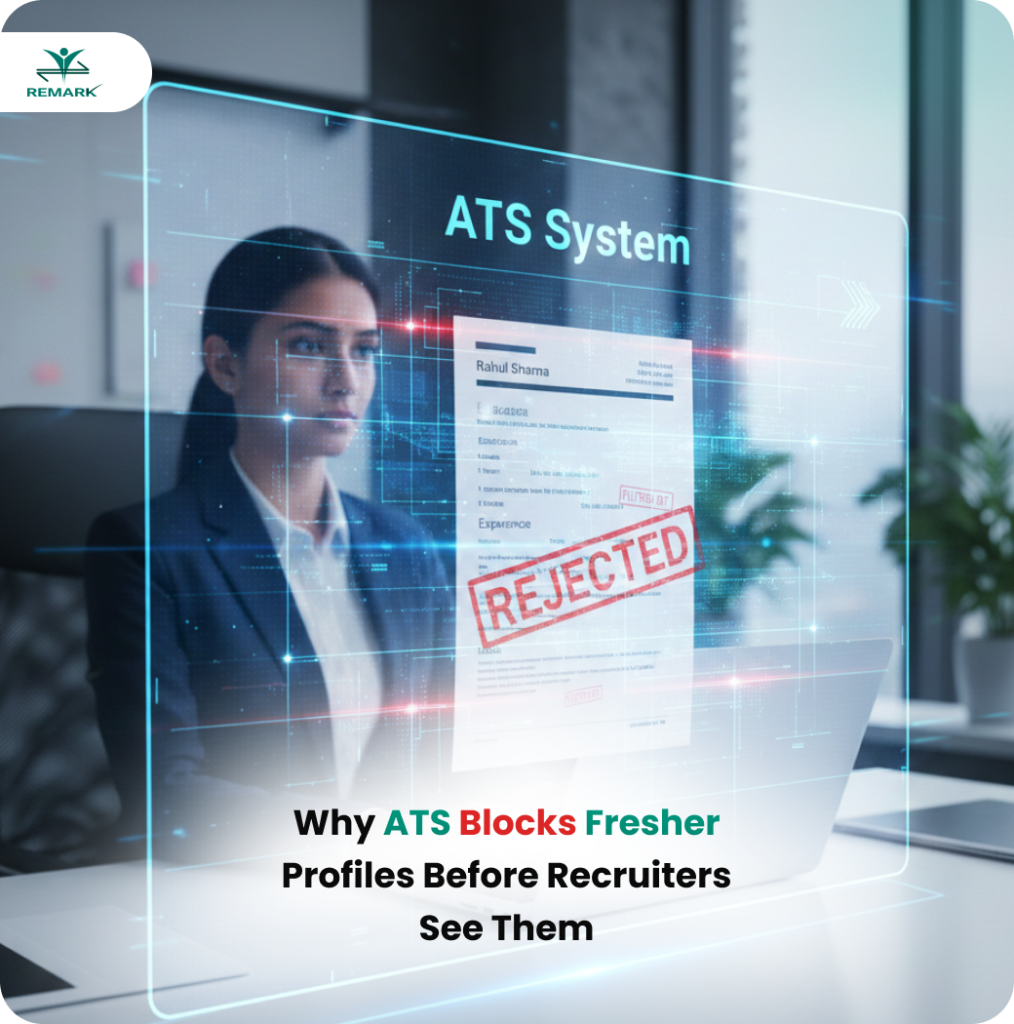
One of the least understood aspects of fresher job rejection is the role of Applicant Tracking Systems (ATS), which is one of the main reasons why freshers not shortlisted in today’s hiring environment. These systems are designed to manage large volumes of applications by filtering, ranking, and categorizing candidates automatically. For many job seekers, especially those facing freshers job rejection in India, ATS can feel like an invisible wall—applications go in, but nothing comes out. ATS tools work by scanning profiles for relevance based on keywords, skill alignment, experience indicators, and behavioral data. Contrary to popular belief, these systems are not looking for perfection. They are looking for a fit. Fit is calculated by how closely a candidate’s profile matches the job description, not by how talented the candidate might become in the future. This distinction clearly explains why freshers not shortlisted repeatedly despite having strong academic records. Their profiles are not optimized for alignment; they are optimized for completeness, which reduces resume shortlisting chances in ATS-based hiring systems.
Another overlooked factor is behavioral scoring. Many online job portals track how candidates interact with listings—how often they apply, how quickly they apply, and whether their past applications resulted in engagement. Mass applying to dozens of jobs in a short time can negatively impact how systems rank a profile. It signals low intent and poor role specificity, which directly affects job application shortlisting. Over time, this behavior can reduce visibility, further reinforcing the cycle where freshers not shortlisted despite high effort, leading to continued job rejection for freshers.
ATS systems also penalize inconsistency. When a fresher applies to vastly different roles—marketing one day, data analysis the next, HR the day after—it becomes difficult for the system to understand their professional direction. Lack of clarity reduces match confidence, which in turn lowers ranking. From the system’s perspective, unclear candidates represent a higher hiring risk, increasing the chances of resume rejection by ATS. This is why modern job platforms emphasize structured profiles, skill tagging, and role-specific matching rather than open-ended applications. Hiring technology is evolving to reduce noise and increase precision. Freshers who understand this shift and adapt their approach gain a significant advantage in fresher job search in India. Those who continue applying blindly often remain invisible, regardless of effort or intent.
Skill Gaps That Freshers Don’t Realize Exist
One of the most overlooked reasons freshers not shortlisted repeatedly is not the absence of skills, but the presence of invisible skill gaps. These gaps are subtle, unspoken, and rarely mentioned in job descriptions, which makes them difficult for candidates to identify on their own. This is a major cause behind fresher job rejection in India, even when candidates believe they meet the requirements. For example, a fresher may list “digital marketing” as a skill, but employers expect familiarity with campaign setup, basic analytics interpretation, or content performance tracking. Similarly, a candidate claiming “software development skills” may lack exposure to version control, debugging workflows, or collaborative coding environments.
These hidden gaps are rarely obvious to freshers because academic and online learning environments do not always simulate real-world constraints. As a result, candidates genuinely believe they are job-ready, while hiring systems detect misalignment. This mismatch strongly contributes to why freshers not shortlisted, even when they meet surface-level requirements and actively apply for multiple roles.
Another dimension of skill gaps lies in communication and context awareness, which directly impacts job shortlisting chances for freshers. Employers value clarity, structured thinking, and the ability to understand business objectives. Freshers who fail to demonstrate these qualities—either through poorly written profiles or unfocused applications—appear less reliable to automated screening systems, increasing the chances of resume rejection by ATS. Organizations working closely with digital transformation and workforce enablement, such as the Visko E-Serve website, often emphasize how critical it is for candidates to align technical ability with real business use cases. Until freshers recognize and address these hidden gaps, job rejection for freshers remains a recurring outcome rather than an exception in the modern fresher job search in India.
Application Behavior That Lowers Shortlisting Chances
Beyond skills and resumes, application behavior plays a powerful but largely invisible role in why freshers not shortlisted in modern hiring systems. Most freshers believe that effort is measured by volume—the more applications sent, the higher the chance of success. Unfortunately, today’s online job portals in India interpret behavior very differently. They analyze patterns, consistency, and intent, not just qualifications. When behavior signals confusion or low relevance, systems quietly reduce a profile’s visibility, which directly impacts job shortlisting chances for freshers.
One common behavioral issue is indiscriminate applying. Freshers often apply to roles without reading job descriptions carefully, assuming that recruiters will decide whether they are a good fit later. In reality, automated systems and ATS resume screening tools evaluate alignment immediately. Applying to unrelated roles within a short time frame creates conflicting signals about career direction. This reduces match confidence and increases perceived hiring risk. Over time, such behavior can push a profile lower in ranking, even for roles where the candidate might have been suitable, leading to repeated job rejection for freshers.
Another overlooked factor is profile completeness and update frequency, which strongly affects fresher job search success in India. Many freshers create a profile once and never revisit it. Hiring systems, however, favor active and evolving profiles because they signal engagement and learning intent. Candidates who refine skills, update experiences, or adjust preferences are more likely to surface in recruiter searches, especially on AI-based job platforms. Platforms and HR ecosystems like ViskoHR, which focus on structured talent data and workforce alignment, highlight how consistency and clarity directly influence shortlisting decisions.
Application timing also matters. Applying too late, too early, or in bulk batches can affect visibility depending on how platforms queue and rank candidates. Freshers rarely receive feedback on these aspects, which makes rejection feel arbitrary. In reality, behavior-driven signals quietly shape outcomes long before human evaluation begins, which explains why freshers not shortlisted even after applying for many jobs.
Why Mass Applying Never Works Anymore
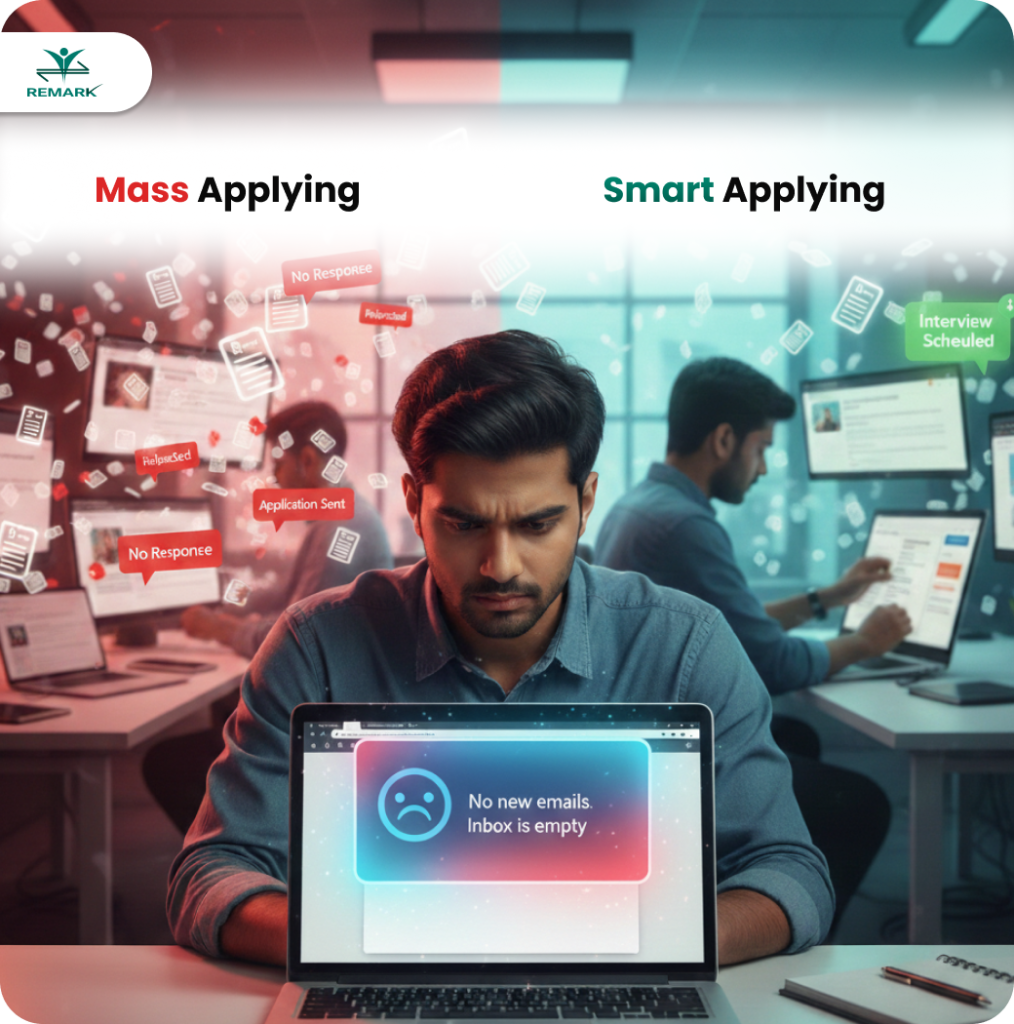
Mass applying feels productive, but in today’s hiring ecosystem, it is one of the least effective strategies for freshers, especially for those struggling with why freshers not shortlisted in modern recruitment systems. The logic seems simple: more applications should mean more chances. However, modern online job portals in India are designed to reduce noise, not reward volume. When a candidate applies to dozens of roles without clear targeting, systems interpret this as low intent rather than high motivation. This directly impacts job shortlisting chances for freshers.
Mass applying dilutes profile relevance. Each application adds data to a candidate’s behavioral history. When this history shows wide role variation and minimal alignment, systems struggle to categorize the candidate accurately. This confusion reduces ranking strength across all applications. Over time, the candidate becomes less visible, reinforcing the cycle where freshers not shortlisted despite increased effort. What feels like persistence to a human appears as inefficiency to an algorithm used in ATS resume screening tools and AI-based hiring platforms.
There is also a psychological cost. Continuous job rejection for freshers without feedback erodes confidence and leads to reactive behavior—applying faster, applying everywhere, and making fewer thoughtful decisions. This downward spiral further weakens application quality and reduces fresher job search success in India. In contrast, platforms built around intelligent matching and skill alignment, such as Remark, encourage focused applications by connecting candidates only with roles where their skill signals show genuine relevance.
This shift from quantity to quality is essential for breaking the rejection loop. The hiring landscape no longer rewards those who shout the loudest; it rewards those who communicate clearly. Freshers who abandon mass applying and adopt targeted, skill-aligned strategies experience fewer rejections and more meaningful engagement. The system is not broken—it is simply optimized for precision, not persistence, which explains why freshers not shortlisted even after applying for many jobs.
How Skill-Based & AI Job Platforms Change the Game
The future of fresher hiring lies in systems that understand potential, not just credentials, especially for candidates struggling with freshers not shortlisted in traditional recruitment models. Skill-based and AI-driven job search platforms in India are designed to address the very problems that cause repeated rejection and explain why freshers not shortlisted despite having basic qualifications. Instead of relying solely on resumes and keywords, these platforms analyze skill signals, learning patterns, and role compatibility to create more accurate matches. This approach benefits both candidates and employers by reducing noise and increasing confidence in fresher hiring solutions.
For freshers, the biggest advantage of AI-based hiring platforms is visibility. When skills are structured, tagged, and contextualized, candidates no longer disappear into application black holes, which is a common reason behind freshers not shortlisted and repeated job rejection for freshers. Their profiles are evaluated based on capability rather than formatting. AI-driven systems also adapt over time, learning from successful placements to refine future matches. This dynamic evaluation reduces bias and opens doors for candidates who may have been overlooked in traditional systems, directly improving job shortlisting chances for freshers.
From an employer’s perspective, skill-based hiring in India reduces onboarding risk. Recruiters gain clearer insight into what a fresher can actually do, not just what they claim. This builds trust in fresher hiring and increases willingness to invest in early-career talent. As these modern recruitment platforms mature, they are reshaping how entry-level jobs in India are filled, creating better outcomes for both candidates and organizations.
Frequently Asked Questions (FAQ)
Most freshers are filtered out by automated systems due to poor skill alignment, unclear profiles, or mass application behavior. Rejection often happens before a recruiter reviews the application.
Yes, mass applying reduces profile relevance in modern hiring systems. Targeted applications aligned with specific skills perform better than high-volume applications.
Resumes matter, but they are no longer enough. Hiring platforms now evaluate skills, learning signals, and role relevance alongside resumes.
Employers prioritize practical skills, basic tool exposure, problem-solving ability, and communication clarity over academic scores alone.
AI screens profiles based on skill match, behavior patterns, and consistency. Understanding how these systems work helps freshers improve visibility.
Conclusion
Repeated job rejection is one of the most discouraging experiences a fresher can face, especially during the fresher job search when effort feels endless and outcomes remain unchanged. However, rejection at scale is rarely a reflection of ability or intelligence. It is a sign that traditional job-search methods no longer align with how modern hiring systems and online job portals operate. Freshers are navigating a market that prioritizes relevance, clarity, and skill alignment over volume and credentials. Understanding why applications fail to convert into shortlists empowers candidates to make better decisions and improve their job search strategy.
By recognizing hidden skill gaps, improving profile clarity, avoiding mass applying, and adapting to AI-based hiring, freshers can shift from being invisible to being relevant in the competitive job market in India. The hiring ecosystem in India is evolving rapidly, and success now depends on learning how to work with the system rather than against it, especially in entry-level job hiring.
Ultimately, rejection is not the end of the journey—it is feedback without words. Freshers who decode that feedback, refine their approach, and focus on skill development, career planning, and smart job applications position themselves for long-term career growth. The goal is no longer to apply more, but to apply smarter, with intention and alignment guiding every step toward career success in India.